

Supreme Court Warns Against Hindering ED Raids: ‘Not a Happy Situation’
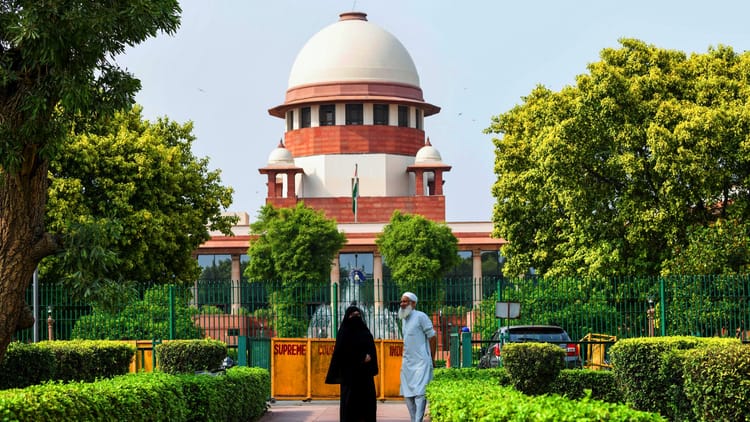
The Supreme Court on Wednesday stated that Chief Minister Mamata Banerjee’s interference during Enforcement Directorate (ED) raids is ‘not a happy situation’. This observation was made by the top court regarding the ED’s raid at the I-PAC office.
Supreme Court’s Stance on ED Raid Interference
A bench comprising Justices Pankaj Mishra and NV Anjaria noted that when the work of a central agency like the ED is obstructed, it cannot be left without a remedy. The court’s remark came after West Bengal argued that a central agency cannot directly approach the Supreme Court under Article 32 of the Constitution.
West Bengal’s Legal Argument
Representing West Bengal, lawyer Shyam Divan argued that the ED is not a separate legal entity but merely a government department. He contended that if a fundamental right is not being violated, a petition cannot be filed under Article 32. Divan warned that allowing central agencies like the ED to use Article 32 could set a ‘dangerous precedent’ for the federal structure. He added that this could bypass constitutional checks and balances, leading one department to use the article against another.
Kapil Sibal’s Input on ED Procedures
Senior lawyer Kapil Sibal, representing Chief Minister Mamata Banerjee, also addressed the court. He stated that the ED cannot direct the Central Bureau of Investigation (CBI) to register an First Information Report (FIR). Sibal explained that the ED cannot intervene or file a petition asking the CBI to register an FIR based on fundamental rights unless a predicate offense is already registered.
Background of the I-PAC Raid Case
The case stems from an ED raid in January at the office of I-PAC, a political consultancy firm. Chief Minister Mamata Banerjee had visited the residence of I-PAC director Pratik Jain during the raid. The central agency alleged that Banerjee’s presence at important locations obstructed the investigation and led to the removal of crucial evidence, including documents and electronic devices. Chief Minister Banerjee has denied these allegations, asserting that the central agency is acting on the ‘political vendetta’ of the central government.
Understanding the ED and Article 32
The Enforcement Directorate (ED) is a law enforcement agency and economic intelligence agency responsible for enforcing economic laws and fighting economic crime in India. Article 32 of the Indian Constitution is a fundamental right that allows individuals to move the Supreme Court for the enforcement of their fundamental rights. The debate in court centered on whether the ED, as a central agency, could directly invoke Article 32 when its operations were allegedly hindered, and the extent to which state interference in such operations is permissible.
Federalism and Central Agency Operations
The arguments presented highlight a crucial tension between the powers of central agencies and the principles of federalism. West Bengal’s legal team argued that allowing direct access to the Supreme Court under Article 32 could undermine the balance of power between the central government and state governments. This concern is rooted in the idea of maintaining a robust federal structure where states have autonomy and are not unduly subjected to central authority without proper constitutional channels.
The Role of I-PAC
I-PAC (Indian Political Action Committee) is known for its work in political strategy and campaign management. The ED’s raid on its office and the subsequent events involving the Chief Minister have brought the firm’s operations and its relationship with political parties under scrutiny. The allegations of evidence obstruction and the Chief Minister’s presence during the raid are central to the ongoing legal proceedings.
Chief Minister’s Defense
Chief Minister Mamata Banerjee’s defense against the ED’s allegations is that the agency is being used as a tool for political persecution. This perspective suggests that the actions of central agencies are not purely based on legal mandates but are influenced by political motives. Such claims often lead to complex legal and political battles, questioning the impartiality and independence of investigative bodies.
Supreme Court’s Role in Upholding Law
The Supreme Court’s remarks underscore its role in ensuring that law enforcement agencies can carry out their duties without undue interference. While respecting the federal structure, the court also emphasizes the need for effective remedies when legal processes are obstructed. The ongoing case will likely clarify the boundaries of interference in central agency operations and the appropriate legal recourse in such situations.